By Essdras M Suarez/ Pulitzer Prize winning photographer
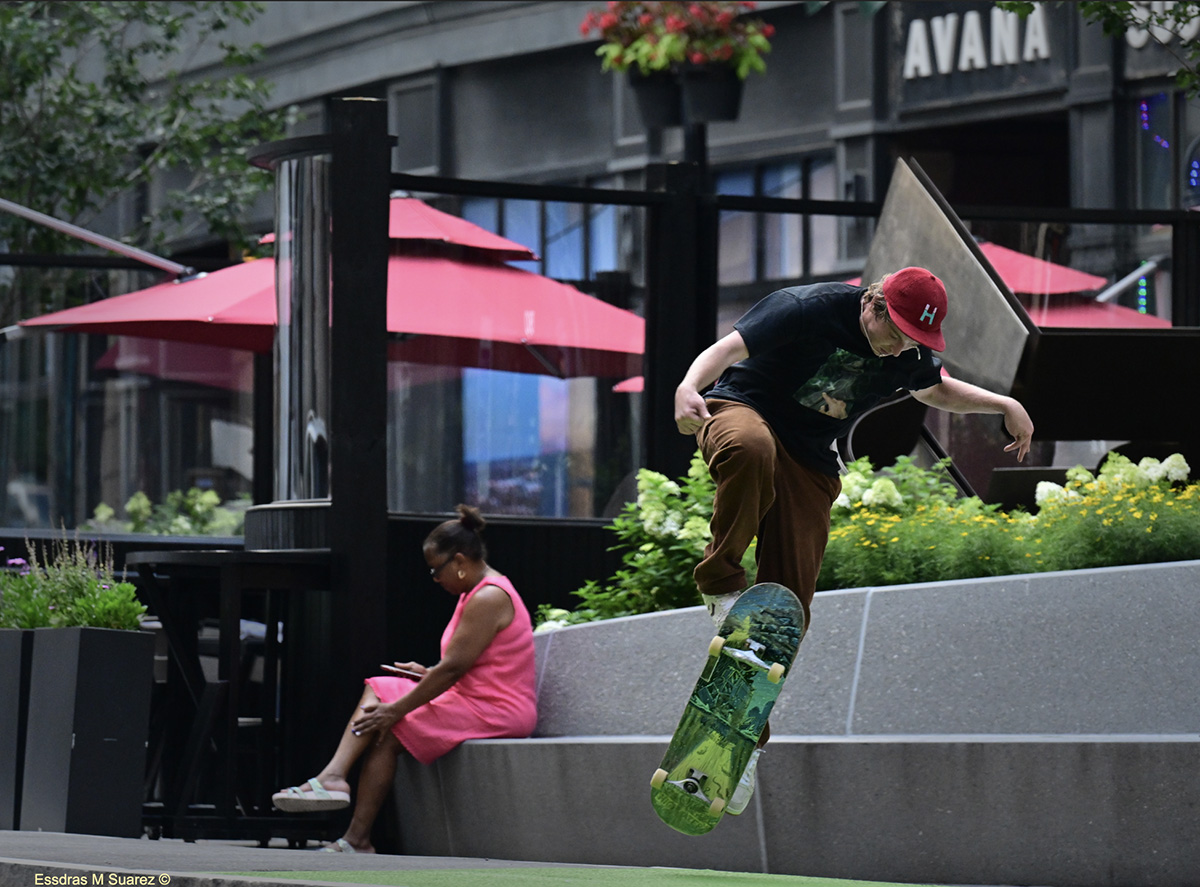
Every time I give a presentation, I revisit and update my slideshow. I don’t want to bore myself, and I certainly don’t want anyone who’s seen me before to feel like I’m recycling content. Recently, while putting the final touches on a Street Photography / Decisive Moments virtual talk for a camera club, I came across this photo. The longer I looked at it, the more fascinating details revealed themselves—and I realized this was one of the greatest gifts my old friend, serendipity, has ever given me.
Before we go any further, a quick caveat. I don’t consider this one of the best photos I’ve ever made, nor is it a great image at first glance. It doesn’t immediately stop you in your tracks. But when you begin to study it—when you start peeling back the layers of timing, coincidence, and synchronicity unfolding across the frame—you realize just how remarkable the capture truly is.
This kind of analysis isn’t theoretical—it’s how images are evaluated at the highest levels. I’ve sat in rooms with editors and photographers where conversations like this unfold, and the focus is rarely on what’s obvious, but on what reveals itself over time.
I figured it was worth breaking it down with you.
First question: does the photo clearly answer what it’s about? Absolutely. At first glance, anyone can tell it’s about a kid on a skateboard mid-trick.
Now, let’s look at what makes it work:
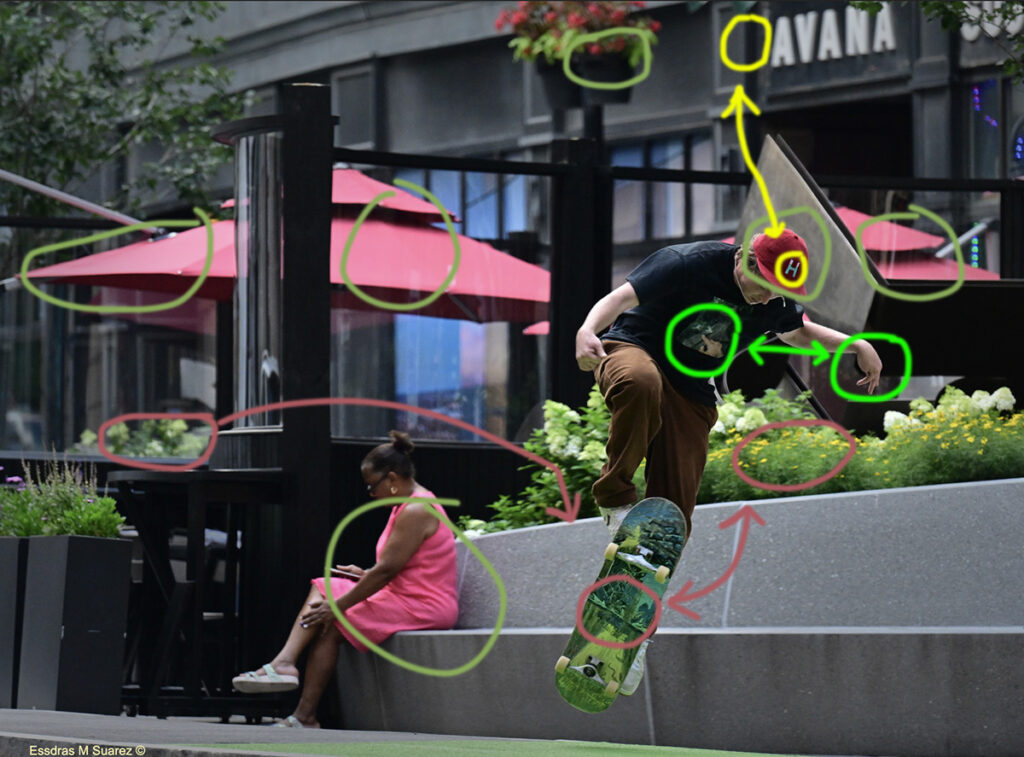
• Frozen action: The skateboarder is suspended in midair, caught at the peak of the trick. That’s the immediate, in-your-face hook.
• Directional flow: Everything in the frame moves from left to right—the skateboarder’s motion, his body lean, the angle of the board. Even the visual rhythm of the scene supports that direction, allowing the viewer’s eye to travel effortlessly through the image.
• Repetition of color: The woman wears a fuchsia dress. The awnings echo a similar tone. The skateboarder’s hat is red. Even the flowers at the top of the frame carry that same color through. The palette is unified, and the eye follows.
• Color harmony: The green of the surrounding plants is mirrored in the underside of the skateboard—same tone, same visual rhythm. The small yellow flowers act as accents, and that same yellow is echoed in the skateboard’s design and matched by the color of its wheels.
• Visual echo: The position of the skateboarder’s left hand—fingers extended—is mirrored in the graphic on his T-shirt. Subtle, but powerful.
• Layered composition: The image naturally separates into layers—the skateboarder in the foreground, the seated woman in the midground, and the café scene in the background. This gives the photograph depth and structure, allowing multiple moments to coexist within the same frame.
• Contrast of energy: The skateboarder is airborne, dynamic, explosive. The woman is seated, still, absorbed in her own world. Motion and stillness, youth and calm—coexisting in a single moment.
• Geometric echo: The triangular structure behind the skateboarder subtly mirrors the angles of his body and board, reinforcing the visual rhythm of the frame.
• The coup de grâce: The detail that stopped me cold. The sign in the background appears to read “AVANA.” The missing letter? The “H.” And where is it? On the skateboarder’s hat. Together: Havana.
This is not a photograph that shouts—it’s one that reveals itself, layer by layer, to those willing to look a little longer.
I didn’t fully grasp the magnitude of this frame when I made it. But now that I see it, I’m grateful, humbled, and honestly a bit in awe. Moments like this remind me that when you’re present—truly present—and ready, the world has a way of aligning in front of your lens.
Thank you, universe.